Facilitation
How to Become a Professional Facilitator (The Realistic Path)

Laura Faint
So, you’re interested in becoming a professional Facilitator. Maybe you’ve run a few workshops at work and really enjoyed the experience. Perhaps you’re a Consultant and you’ve heard that adding facilitation to your services can help you work more efficiently and charge more. Maybe you want a complete career change and feel compelled to do something more flexible and impactful.
Whatever brought you here, the good news is that learning facilitation is an excellent career-move, and one that we genuinely believe can help you “future-proof” yourself professionally in an uncertain, ever-changing job market.
From what we’ve seen in our private facilitation communities, skilled Facilitators can charge up to (and over!) $10,000 per day. Many work independently, choosing their clients and schedule. The work is varied, challenging, and meaningful.
And perhaps even more importantly, becoming a Facilitator can help you make the shift from “order-taker” to “strategic partner.” Instead of executing tasks that are increasingly becoming commoditized by AI, you’re guiding decisions at the highest and most strategic levels.
What Does a Professional Facilitator Actually Do?
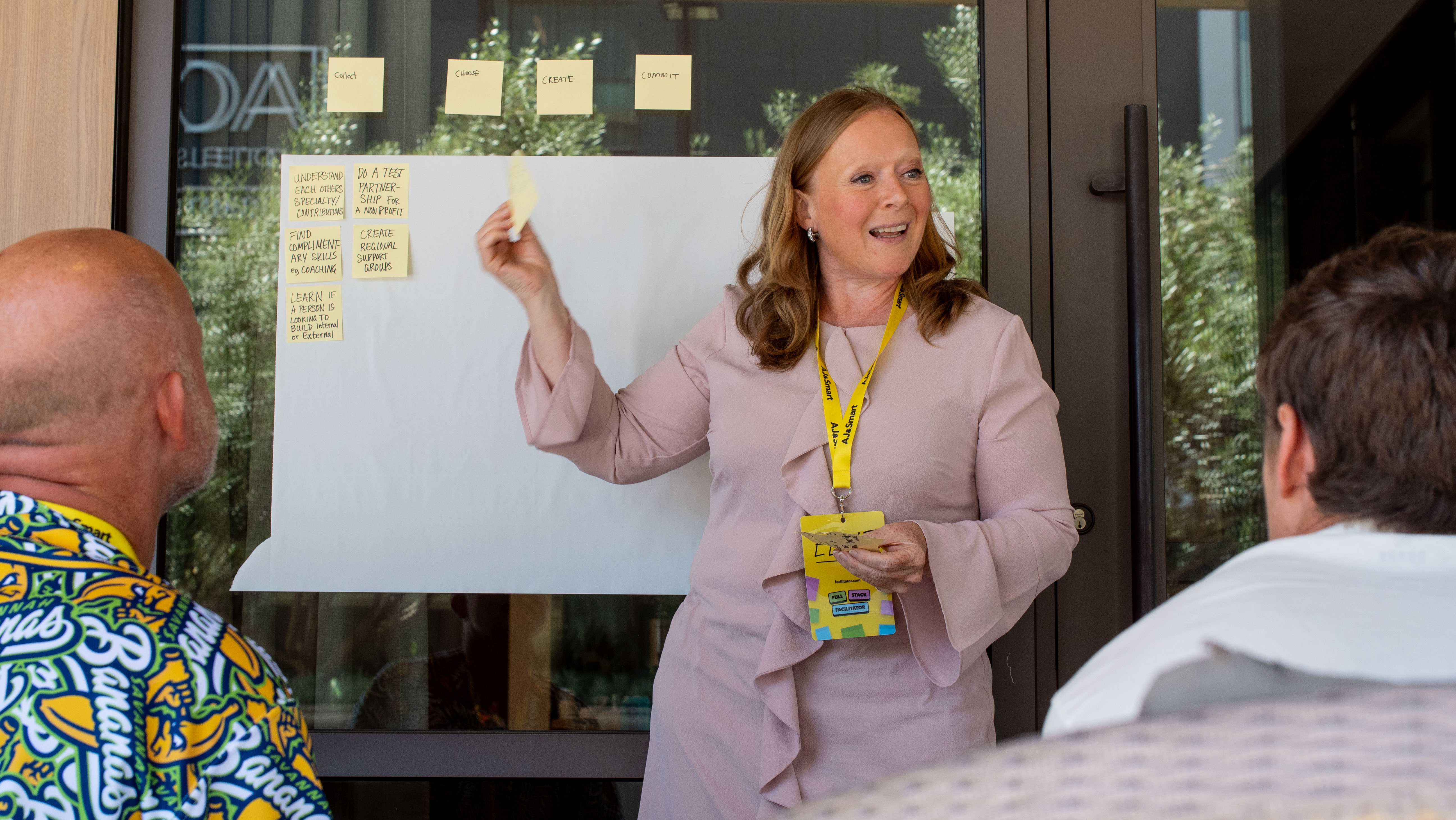
Professional Facilitators get paid to help groups think and work together effectively, taking on the “burden” of collaboration complexity and allowing teams to focus on doing their best work. This takes place in many forms:
Strategy and planning sessions - Helping leadership teams set direction, prioritize, make decisions
Workshops - Design thinking, innovation sprints, problem-solving sessions
Team offsites - Quarterly planning, team building, retrospectives
Stakeholder alignment - Getting different parties on the same page
Training delivery - Running interactive learning sessions (facilitative training, not just lecturing)
Meeting facilitation - Making regular meetings actually productive (yes, people pay for this!)
Some Facilitators specialize in one format, others are generalists who are able to adapt to facilitate any type of session. Both paths work and bring immense value to teams.
The Key Pillars to Mastering Facilitation
There are four components to facilitation mastery. These help to give you a solid foundation to build a successful facilitation career. They are:
Mindset and Theory - Understanding the Facilitator’s role and the principles behind facilitating great sessions
Facilitation Skills - The ability to lead any team confidently, including reading rooms and improvising
A Robust Toolkit - Dozens of exercises at-hand that you can combine and adapt for any scenario (Sailboat, Lightning Decision Jam, 10 for 10, etc.)
Battle-Tested Workshop Recipes - Pre-designed workshop formats that get results (Strategy Signal, Design Sprints)
Most facilitation training focuses only on the toolkit. But without the other three, you’re just following scripts and steps. The goal is to master what we call “Emergent Facilitation” - the ability to walk into any room with just sticky notes and marker and a loose plan, hear the challenge, and design the perfect workshop on the fly, navigating challenges and complexity confidently as it emerges
Building Facilitation Skills
While much of being an excellent Facilitator relies on your ability to confidently handle real-time complexity as it emerges in a meeting or session (our Emergent Facilitation System teaches you how to do that), there are some key skills that are also extremely helpful when it comes to building a career as a Facilitator.
They are:
Session design - Knowing how to structure a workshop/session to achieve specific outcomes. What activities to use, how to sequence them, how to allocate time, and how to end sessions with clear next steps, every time.
Group dynamics - Understanding how groups work, when to let discussions run, when to intervene, how to handle different personalities.
Presence - Being calm, confident, and grounded even when things get messy. Participants need to trust that you’re in control.
Interpersonal skills - Drawing people out of their shells, managing difficult participants, navigating conflict, making everyone feel heard.
How to Develop These Skills
Free resources - We’ve got over 100 hours of free facilitation training on our YouTube channel. Many Facilitators have started their facilitation careers there.
Structured training - When you’re ready to accelerate, formal programs provide methodology, practice opportunities, and expert guidance. Our Workshopper Master program is an excellent place to start when you’re ready to pursue facilitation seriously.
Practice - Every meeting you run is practice. Seek as many opportunities to facilitate as you can. A great place to start is bringing one workshop exercise into your next meeting, even if it’s only for 5 minutes, it's still valuable practice that’ll help build your confidence.
Get feedback - Ask participants what worked and what didn’t. Record yourself and review. Find a mentor who you trust and who can observe and give honest feedback.
The Best Facilitators Learn “Emergent Facilitation”
The best Facilitators don’t just have a toolkit of exercises and workshops that they’ve memorized. Instead, they’ve focused on mastering the ability to confidently respond to whatever emerges in a collaborative session, in real-time.
After 15+ years of running a facilitation business, we realized that preparing Facilitators for the complex, messy, and unpredictable nature of real-time collaboration was the critical “big domino” that actually helped them thrive and build successful facilitation careers.
That’s exactly why we created our own “method” called the Emergent Collaboration System (ECS®).
ECS® is built on five components:
Insights - Understanding how groups actually work (not how you wish they worked)
Principles - Beliefs that guide your decisions when there’s no obvious answer
Structures - Flexible frameworks you can adapt to any situation
Skills - The interpersonal stuff that can make or break a session
Activities - A set of exercises you can combine and remix on the fly
And what happens when you learn ECS®? Instead of learning “do this, then this, then this”, you develop the judgment and confidence to figure out exactly what’s needed in each moment.
You no longer need to rely on everything going smoothly, everyone being in a good mood, and on brute forcing the agenda/workshop you’ve prepared, even if it doesn’t seem to be playing out as you’d hoped.
With ECS®, you still show up with a solid plan, but you can rest assured that you have what you need to improvise and change course accordingly based on what emerges in the session itself.
That’s what separates Facilitators who can only handle predictable sessions from those who thrive in whatever is thrown at them. It's what differentiates average Facilitators from the best, and what leads the best to getting booked again and again by their clients.
Getting Experience
Learning skills without experience keeps you in the theory, and to build a successful career as a Facilitator, you need reps.
Here’s how to start getting reps in:
Start Where You Are
Most Facilitators don’t jump straight into paid gigs. They start facilitating in contexts they already have access to. For example:
Internal facilitation - If you’re currently employed, volunteer to facilitate team meetings, planning sessions, retrospectives, or even just offering to run a simple “Ice Breaker” exercise at the start of your next team meeting

Non-profit work - Organizations that can’t afford to hire experienced Facilitators are often happy to have help. It’s great practice for you, and extremely valuable for them.
Community groups - If you’re part of any clubs, associations, or volunteer organizations then a great place to start is by offering to facilitate an upcoming meeting or session.
Friends and networks - Know someone running a startup? Offer to facilitate their next strategy session.
Assist peers - If you’re part of a facilitation community (like our Workshopper Master “Facilitator Pro” group) then offer to assist your peers who are slightly ahead of you with their facilitation gigs for free. This is a powerful way to gain real experience in a lower-stakes supporting role.
In general, building a strong portfolio of experience and gaining confidence beats getting paid at this stage, so take up as many opportunities as you possibly can. From what we’ve observed, it really pays off down the line.
The Awkward “Getting Started” Phase
After you’ve got some practice, there’s an uncomfortable phase where you are good enough to facilitate, but you don’t have a solid enough track record to command premium rates.This is normal, and the best Facilitators, who go on to charge top rates, go through this phase too.
Here are some ways to navigate this phase:
- Charge lower rates with the view to increasing them as you gain experience
- Work with smaller clients who’ll be more likely to take a chance on you
- Subcontract for established Facilitators (again, if you’re part of a community like our Workshopper Master “Facilitator Pro” group then this is a great place to find opportunities like this)
- Combine facilitation with other services you already offer
Again, the goal is reps to build your confidence and experience portfolio. Get as many as you can!
Building Your Reputation
Getting experience means you can do the work confidently and get great results. Reputation means people know you can do the work confidently and get results.
So, how do you build your reputation as a Facilitator?
Join a Facilitation Community
Connect with other Facilitators and bring value to them (share insights based on your subject matter expertise, offer to help them for free). From what we see inside our facilitation communities, once trust is built then it can often lead to exciting collaborations and Facilitators referring work to each other.
If you can’t afford to join a high-level professional community (like our Workshopper Master “Facilitator Pro” group) then our free Facilitator Club community (9,800+ members) is a great place to start to learn what others are doing, share your experiences, and build relationships.
Create Content
You don’t need to be an experienced Facilitator to document and share what you know on a platform like LinkedIn. Generally people appreciate seeing someone’s learning journey (even if it’s “unpolished”), and getting access to insights as you’re learning them. Also, it’s helpful that when a potential client looks you up before hiring you, that they find some thoughtful content about facilitation.
Referrals
A huge amount of facilitation work comes from referrals. We see it time and time again: happy clients tell colleagues, other Facilitators refer overflow work to the Facilitators they trust, a client moves to a new company and wants to hire you to help them there because of the great work you did at their previous company. Referrals matter and it’s worth thinking about optimizing for them from day one.
This means: do great work for every client. Take every project seriously (even the free ones), follow up, stay in touch, keep giving value even if you’re not (yet) getting paid for it. Make it easy for people to remember you when opportunities come up.
Niche Down (Maybe)
Some Facilitators succeed as generalists who can facilitate any type of session, for any type of company, in any industry. Others build reputation in specific niches: design sprints, strategy facilitation, tech companies, healthcare, executive teams.
Niching can make you more memorable and can make marketing yourself easier. For example it’s a lot easier to be specific about what you do and who you help: “I’m the person who does investment strategy facilitation for startups” is easier to remember than “I’m a facilitator.” Niching is not mandatory, but it is worth considering.
Learn Marketing & Sales
You can be the best Facilitator on the planet but if no one knows about you and no one can find you then it doesn’t matter. The best and most successful Facilitators also learn how to sell their services efficiently. That doesn’t mean becoming a sleazy salesperson, but it does mean taking sales/marketing seriously and investing in learning as much as you can. This is why we put such a huge emphasis on sales & marketing in our Workshopper Master program.

What Can You Earn as a Facilitator?
Ok now to the big question:
What do Facilitators Charge?
The range is pretty huge depending on experience, niche, and client type, but here’s a general “rule of thumb”:
Starting out: $500-1,500/day - Building portfolio, smaller clients, temporarily lower rates compared to time spent on a project
Established: $2,000-5,000/day - Solid track record, good clients, confident in your value and abilities
Premium: $5,000-10,000+/day - Top reputation, high-stakes clients, good at sales and marketing
These are rough ranges. Geography, industry, and many other factors affect what you can charge.

But here’s where it gets really interesting: the big shift is going from charging for time to charging for strategy and decisions.
Traditional consultant math: bill hours, cap out somewhere, always a “on the treadmill” feeling.
And here’s how it could look when you make the transition to being considered a Strategic Partner to clients:
Six strategy workshops per year at $10k each = $60k for 12 days of actual work.
Then, you can add advisory retainers, additional workshops, and you’re looking at a very strong income with real freedom.
To give you some inspiration, here are actual results from some of our students:
- Emily closed a $40k workshop deal
- Ren landed a €14k Sales Strategy Sprint
- Jean-Michel now sells workshops at $5k+/day
- Javier charged $4,000 for a 2-hour workshop
- Loell quit corporate, now focuses entirely on workshop facilitation
The key insight: price strategy and the value of good decisions, not time or artifacts.
Clients aren’t paying for hours spent or documents created. They’re paying for the clarity workshops and facilitation bring - and the understanding of the immense cost of NOT having that clarity.
Do You Need Certification?
Certificates of completion are what you get after finishing most training programs, including ours. It’s proof you did the work, they’re great for LinkedIn, and they show your potential clients that you’ve invested in developing your skills.
Industry certifications are different. Bodies like the IAF (International Association of Facilitators) offer credentials like the CPF (Certified Professional Facilitator). These require demonstrating real-world experience, and completing a training program often isn’t enough.
Here’s the truth though: from our experience of training tens of thousands of people, most successful Facilitators work without any “formal” facilitation certification. They master the skills through a program, get real-world practice, and build reputation through results and referrals.
Credentials can help when:
- You don’t already have a formal education (a University degree, for example)
- Your employer requires that you get a formal credential
- You need a certification from an official certification body to be able to apply for funding
Credentials matter less when:
- Your company or clients don’t specifically require it (in most cases a certificate of completion is more than enough)
- You already have a professional track-record (even if it’s in something different to facilitation)
- You don’t want to do extra logistical work to get a formalized certification when a certificate of completion (from a recognized training producer) feels like enough
All of our programs include certificates of completion that many Facilitators use on LinkedIn, include in their CVs, and reference in proposals for client work.
If you want industry certification (like IAF CPF), our training can help prepare you, but that credential comes from the certifying body, not from us.

A Realistic Timeline
Everyone’s path to building a facilitation career is different, but here’s a rough sense of that the timing could look like if you put in the work:
Months 1-3: Build your foundation
- Learn fundamentals (ideally start a facilitation training)
- Facilitate wherever and whenever you can and get feedback
- Start documenting your experience
Months 3-6: Get practice
- Get deeper training if you’re serious
- Seek any facilitation opportunities available, collaborate with working Facilitators
- Build relationships in communities where professional Facilitators spend time (like our Workshopper Master “Facilitator Pro” group)
- Do some low-paid facilitation work for your portfolio
- Learn as much as you can about sales & marketing
Months 6-12: Going out on your own
- Start looking for paid gigs of your own
- Raise your rates as track record builds
- Build your referral network
- Create and publish content (informal content about your learning journey)
- Possibly begin transitioning from other work to full-time facilitation
Month 12 and onwards: Established Facilitator
- Paid facilitation work is consistent
- Rates reflect your experience and value
- Reputation generating referrals
- Embodying “Strategic Partner” role to clients
- Potentially specializing or expanding
These benchmarks are not a promise, and they’re not what everyone experiences. Some people move faster. Some slower. Some decide facilitation as their main focus isn’t for them, and instead they use it as a tool for something else. Some end up going totally all-in and build a business (with employees) focused on facilitation.
The main thing to know is that your timeline and progress entirely depends on your commitment to learning, getting practice, and staying focused on your goal of building a career as a Facilitator.
Is This Right for You?
Learning facilitation can be an amazing career move for lots of different types of people, but it’s worth saying that it isn’t for everyone.
Consider whether you:
Genuinely enjoy working with groups
Can stay calm when things don’t go as planned
Like variety (different clients, contexts, challenges)
Are genuinely excited by the idea of helping teams make progress
Are comfortable with some income variability (especially early on)
Can handle the business side of being self-employed
If you’re nodding along, facilitation might be a great fit for you.
Getting Started
Here’s the path we’d recommend:
1. Learn the basics - Start with free resources. Our YouTube channel has 100+ hours of free content. See if facilitation resonates.
2. Practice immediately - In the next meeting you run, apply something you’ve learned. Don’t wait until you feel “ready.”
3. Invest in training when it makes sense - When you want deep-dive learning, methodology, expert coaching, and community, structured programs like Workshopper Master can massively accelerate development.
4. Get reps anywhere you can - Internal meetings, volunteer, ask friends, do cheap gigs. Experience builds confidence and portfolio.
5. Build relationships - Connect with other Facilitators, join communities, learn from people ahead of you on the path.
6. Be patient but persistent - This isn’t an overnight success thing, but if you keep improving and keep showing up, opportunities tend to compound.
The Bottom Line
Becoming a professional Facilitator is a real career path with huge potential. Companies pay good money for skilled Facilitators who can help their teams do their best work.
But it takes time to get there. You need to build actual skills, accumulate experience, and develop a reputation. So start learning, start practicing, be patient, and stay committed even when things feel slow. The people who do that have the absolute best chance of building a high-paid, fulfilling facilitation career.
Free Facilitation Resources!
Join the Facilitator.com newsletter to get free Facilitation tools, news,
methods and resources right to your inbox.
Sent sparingly. Always relevant.